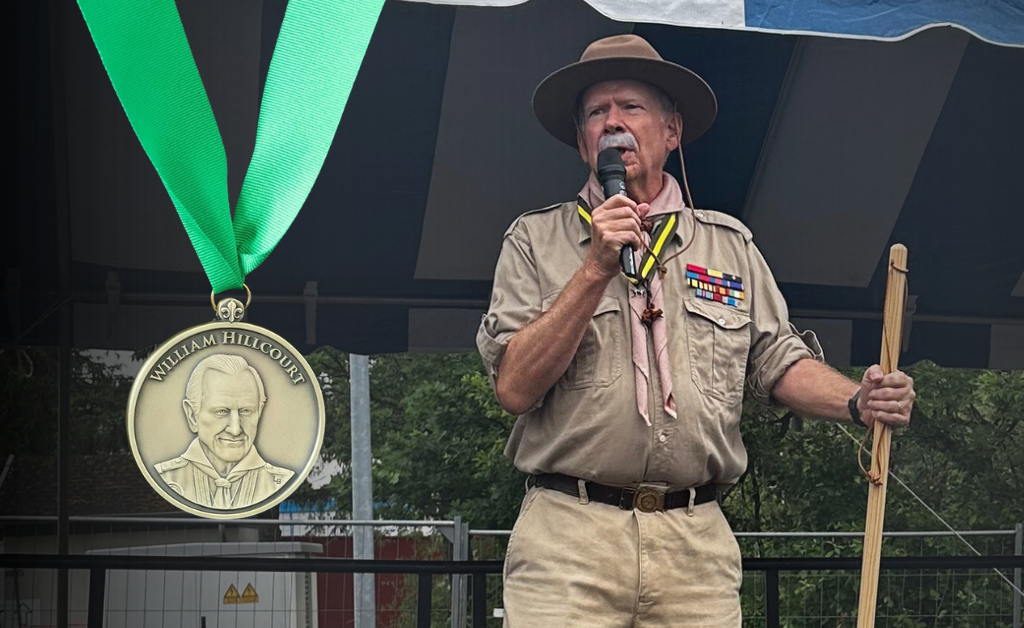
Greg Pedlow Honored with the Hillcourt Foundation Bronze Medal
Somewhere in Greg Pedlow’s home is a handwritten letter from Robert Baden-Powell, dated 1910, laying out an idea for a military branch of Scouting that never came to be. It’s the kind of object most people would frame and leave at that. Greg used it to teach a merit badge.
That habit, chasing a piece of history until it becomes something useful to share, is exactly why the Hillcourt Foundation has awarded Greg its Bronze Medal, given to volunteers who’ve made an outstanding contribution to preserving and sharing the history of Scouting. The path to that letter, and to the honor itself, started more than two decades ago with a much smaller question.
A Unit Historian’s Beginning
Greg’s journey into Scouting history didn’t start with grand ambitions. In the late 1990s, while serving as Chair of Troop 125 at SHAPE, he simply wanted to know more about the unit he was leading. That curiosity sent him digging through old unit charter files, piecing together the troop’s origins at SHAPE Headquarters outside Paris in 1953, just a year after the headquarters itself opened, and tracing its eventual move to Belgium when SHAPE relocated. Along the way, he recovered the names of early Scoutmasters and Committee Chairs whose contributions might otherwise have been lost to time. It was patient, unglamorous work. It also planted the seed for everything that followed.
Becoming Baden-Powell
In 2002, Greg was asked to serve on staff for TAC’s first Wood Badge for the 21st Century course at the Kandersteg International Scout Centre. The new course design called for something ambitious: an opening campfire presentation on the life of Lord Baden-Powell, delivered either as a straightforward lecture or by someone portraying B-P himself. Greg volunteered for the latter.
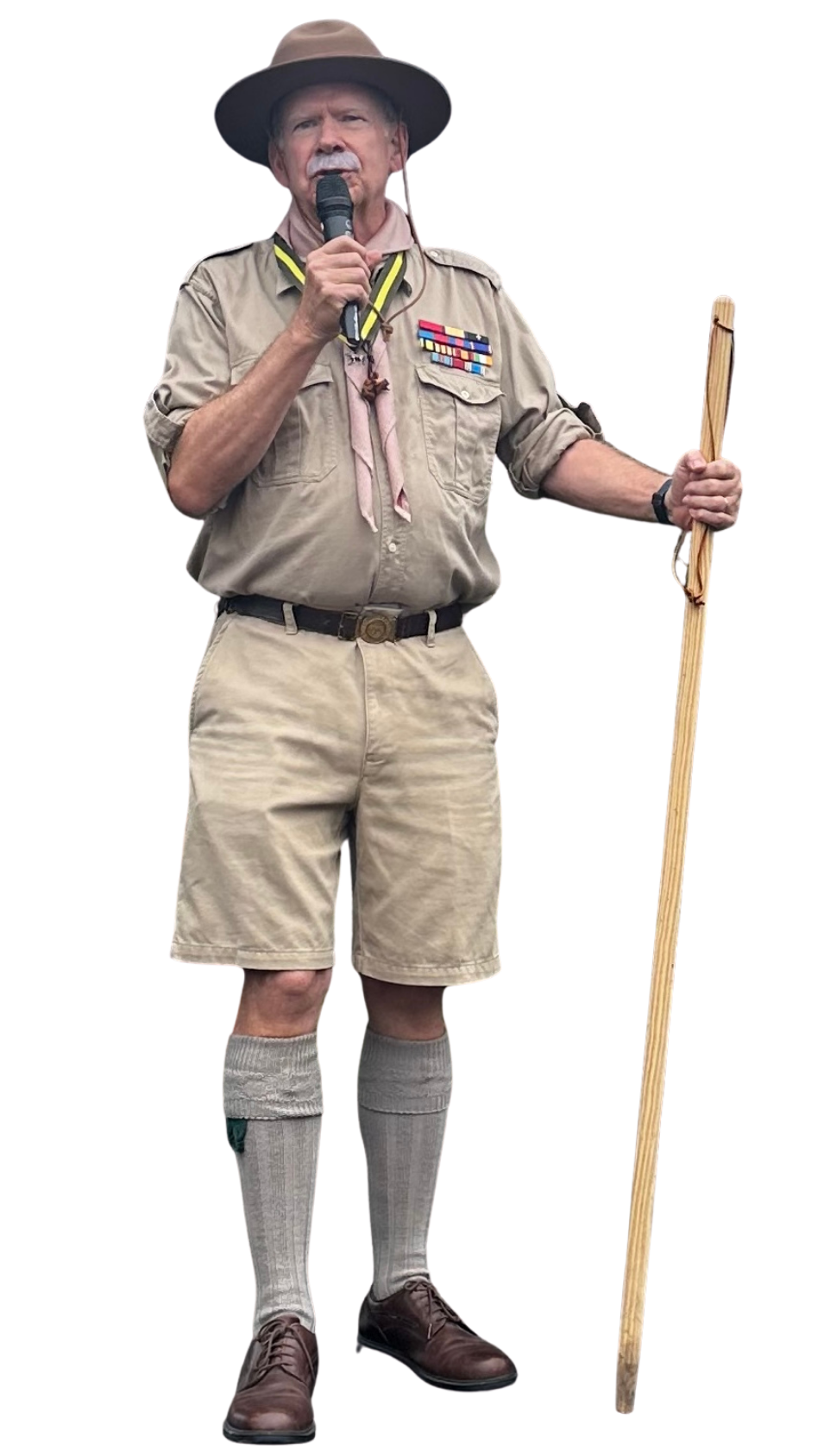
He assembled a replica of Baden-Powell’s uniform, grew a moustache to complete the resemblance, and stepped into the role of Scouting’s founder for the assembled course participants. What began as a one-time assignment became something close to a tradition. In the years since, Greg has re-created Baden-Powell at nearly every TAC Wood Badge course, often returning to do it even in years when he wasn’t otherwise on staff.
The portrayal has never stood still. Over time, Greg has layered in more of the story: the founding of Scouting itself, and the contributions of figures like Ernest Thompson Seton and Daniel Carter Beard to Scouting’s development in America. He’s also chased down the finer details of the uniform, sourcing accurate reproductions of B-P’s medal ribbons and hand-making a replica of the distinctive red-yellow-green hat plume Baden-Powell was known to wear.
Building a Collection Worth Preserving
The Wood Badge presentations pushed Greg toward a broader interest in the history of Scouting as a whole, and over the years he has assembled a substantial personal collection of books, magazine articles, and documents charting that history, including a copy of the very first BSA handbook from 1910, co-written by Baden-Powell and Ernest Thompson Seton.
The centerpiece of the collection, though, is something rarer still: a handwritten letter from Baden-Powell, dated 1910, discussing a proposal to create a military branch of Scouting, an idea that was ultimately never realized. It’s the kind of artifact that turns a personal hobby into a genuine historical resource.
Greg has put that resource to work, drawing on his collection to teach the Scouting Heritage Merit Badge at Merit Badge Fairs and Merit Badge Universities, giving today’s Scouts direct access to the movement’s earliest history.
A Fitting Recognition
From charter files in a unit binder to a handwritten letter from Scouting’s founder, Greg Pedlow’s path has been one of steady curiosity rewarded with real discovery. The Hillcourt Foundation Bronze Medal recognizes exactly that kind of contribution, the quiet, sustained work of a volunteer determined to make sure Scouting’s history isn’t forgotten, but taught, worn, and brought to life for the next generation.
Congratulations, Greg, and thank you for keeping our history alive.
- Your Voice Shaped the Conversation: 2026 Volunteer Survey Results
- Greg Pedlow Honored with the Hillcourt Foundation Bronze Medal
- Wood Badge 2027 Course Director Announced

- Weird Science in Belgium: Charlemagne District’s Fall Cub-o-ree a Hit with Families

- Individual Registration Renewal: Your 2026 Guide

- Setting Sail for Camp Kenya 2026: Sea Scouts Prepare for Majini Camp

- Brotherhood, Cheerfulness, and Service Return to Stuttgart
- New Hazardous Weather Course: Stay Ready. Stay Safe. BecomeWeather Smart.

- Building Leaders Through Adventure: IOLS Training in the Mediterranean District
- KISC Training Camp: A Weekend of Skills, Teamwork & Scouting Fun!
- October 17 is TAC Open Store Day in Brussels
- How to Merge Your Member ID
- Tax-Deductible Scouting America Donations in Germany
- 220 Kits, 138 Hours, One Mission: Serving Students in Kenya

- Does your unit have a dedicated New Member Coordinator?

- Cub Scout 4-Month Plan Workshops